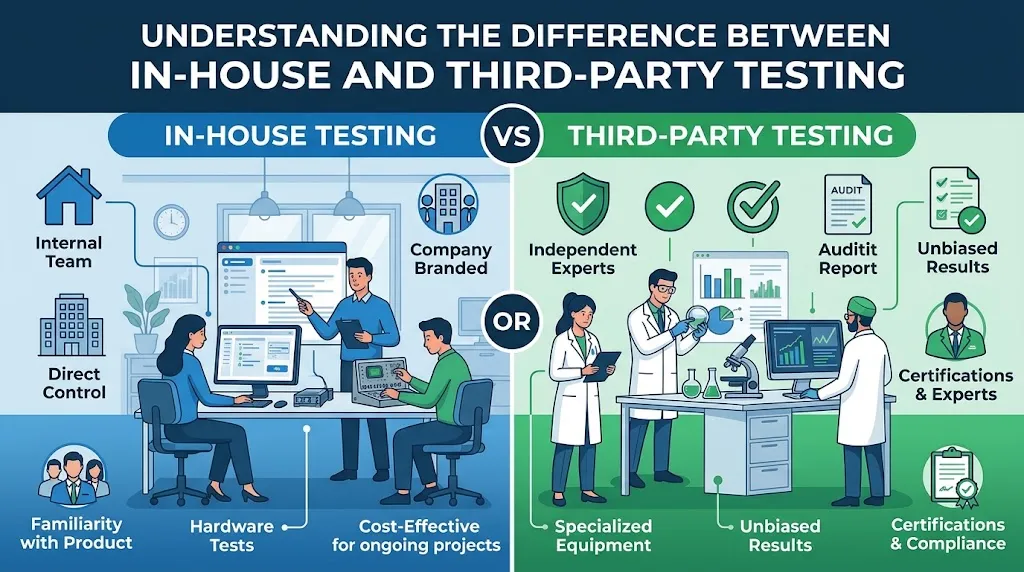
Laboratory testing plays an important role in documenting the characteristics of research materials. However, not all testing is performed under the same organizational arrangement. Some suppliers conduct analytical work through their own laboratory facilities, while others use independent third-party testing laboratories.
Understanding the difference helps research organizations assess documentation, identify the source of analytical findings, and understand the scope of available reports.
For laboratories reviewing research materials in the UAE, Remy Research provides a supplier reference point for exploring product information and associated laboratory documentation.
All materials discussed in this article are intended strictly for in-vitro laboratory research only. They are not intended for human or veterinary use.
1. What Is In-House Testing?
In-house testing refers to analytical work performed within an organization’s own laboratory or testing facility.
A supplier may maintain internal analytical processes to review incoming materials, monitor documentation, or support its quality-management procedures.

Depending on the facility and its capabilities, in-house testing may involve analytical instruments, documented procedures, trained personnel, and internal review processes.
The exact scope of in-house testing can vary significantly between organizations. Therefore, the term alone does not establish which methods were used or how a particular result was generated.
2. What Is Third-Party Testing?
Third-party testing is performed by a laboratory that is organizationally separate from the supplier.
A supplier may submit a sample to an external analytical facility and receive a report containing the laboratory’s findings.
Third-party reports may provide additional documentation from an organization outside the supplier’s internal operations.
However, third-party status alone does not guarantee that every report is comprehensive, independently verified, or relevant to every supplied batch. The laboratory, method, sample identity, and report scope still need to be reviewed.
3. Key Differences Between the Two Approaches
The main distinction is who performs the analysis and how the testing process is organized.
| Consideration | In-House Testing | Third-Party Testing |
| Testing organization | Supplier’s own facility | Separate external laboratory |
| Operational relationship | Internal to supplier | Outside supplier organization |
| Reporting process | Internal documentation system | External laboratory report |
| Communication | Direct supplier process | Supplier and external laboratory coordination |
| Documentation review | Requires method and process details | Requires laboratory and report details |
| Independence | Part of supplier’s operations | Organizationally separate from supplier |
Neither arrangement should be assessed solely by its label. The quality and relevance of the documentation depend on the actual testing process and evidence provided.
4. Understanding Laboratory Independence
One reason organizations use third-party testing is to obtain analytical findings from a separate laboratory.
Organizational separation can provide a different perspective from the supplier’s internal review process. However, independence should not be confused with automatic accuracy or completeness.
Researchers should consider whether the laboratory is clearly identified, whether the report refers to a specific sample, and whether the analytical method is appropriate for the stated purpose.
Where independence or accreditation is claimed, supporting information should be available rather than assumed.
5. Reviewing the Testing Method
The analytical method is important regardless of who performs the test.
For example, High-Performance Liquid Chromatography (HPLC) may be used to separate components and produce chromatographic data. Liquid Chromatography–Mass Spectrometry (LC-MS) combines separation with mass-based analysis.
The presence of either method on a report does not automatically establish the same level of information. Interpretation depends on the specific procedure, conditions, instrument configuration, and reporting approach.
A meaningful review should identify what the method was intended to measure and what conclusions the resulting data can reasonably support.
6. What Should an In-House Testing Record Include?
When reviewing an in-house report, researchers may look for:
- The name of the organization performing the analysis.
- The sample or material identification.
- The batch or lot reference, where applicable.
- The analytical method used.
- The date of analysis.
- The reported findings.
- Relevant instrument or procedure information.
- The person or department responsible for reviewing the record, where stated.
These details help readers understand how the internal record was generated.
A supplier’s statement that a material is internally tested should not replace the actual supporting documentation.
7. What Should a Third-Party Report Include?
A third-party report should identify the external laboratory and provide sufficient information to understand the analysis.
Relevant details may include:
- Laboratory name.
- Report identification number.
- Sample reference.
- Product or material description.
- Batch reference, if supplied to the laboratory.
- Testing date.
- Analytical method.
- Reported results.
- Relevant limitations or notes.
The report should also make it clear which sample was analysed. A report relating to one submitted sample should not automatically be treated as evidence for every batch or format associated with the same product name.
8. Comparing Reports Without Making Unsupported Assumptions
When both in-house and third-party reports are available, researchers may compare the information they contain.
However, comparing numerical values without understanding the methods can be misleading.
Before comparing findings, consider:
- Were the same samples analysed?
- Are the batch references consistent?
- Were comparable analytical methods used?
- Are the testing conditions sufficiently described?
- Are the reported measurements expressed in the same way?
- Do the reports have similar analytical scopes?
Different methods or reporting conditions can produce results that are not directly comparable. Any comparison should account for these differences.
9. Batch Identification Still Matters
Whether testing is performed internally or externally, sample identification remains essential.
A report should be connected to a clearly identified sample. Where a supplier associates that sample with a particular batch, the relationship should be documented.
If the supplier maps one tested sample to several formats or product listings, that association should be described accurately. It should not be presented as separate testing of each format unless additional reports support that statement.
Likewise, a historical report does not automatically establish the analytical characteristics of a later shipping lot.
10. Questions to Ask About Testing Arrangements
Laboratories reviewing supplier documentation can ask practical questions such as:
- Was the analysis performed internally or by an external laboratory?
- Which organization issued the report?
- What analytical method was used?
- Which sample was tested?
- Is a batch reference available?
- What does the report actually establish?
- Are any product formats associated through supplier mapping?
- Are the limitations of the report clearly stated?
These questions help establish the context of a report without relying on broad statements about testing practices.
11. Documentation Transparency for UAE Research Buyers
When comparing Research Peptides UAE documentation, laboratories should focus on the information available rather than assuming that one testing arrangement is always superior.
An in-house report can be useful when its method, sample identity, and scope are clearly documented. A third-party report can also provide useful information when the issuing laboratory and analytical process are identifiable.
The important consideration is whether the documentation allows the reader to understand what was tested, how it was tested, and which material the findings relate to.
12. Practical Review Checklist
Before filing an analytical report, laboratory personnel can review the following:
- Is the testing organization identified?
- Is the testing arrangement clear?
- Is the sample identifiable?
- Is the batch reference recorded, where applicable?
- Is the analytical method stated?
- Is the testing date available?
- Are the findings presented clearly?
- Are relevant limitations explained?
- Is any supplier-provided sample mapping disclosed?
- Does the report support only the conclusions stated?
This checklist can be incorporated into routine supplier-documentation reviews.
Conclusion
In-house and third-party testing are different organizational approaches to analytical work. In-house testing is conducted within a supplier’s own operations, while third-party testing is performed by a separate laboratory.
Neither label alone establishes the quality, completeness, or relevance of a report. Researchers should examine the laboratory identity, analytical method, sample reference, batch connection, and limitations before interpreting the findings.
A careful documentation review helps research organizations maintain accurate records and avoid extending analytical conclusions beyond the sample and testing scope described.
All materials discussed in this article are intended strictly for in-vitro laboratory research only and are not intended for human or veterinary use.