Traffic-control plans often involve several different risks at the same time. A construction entrance may need a strong physical boundary, while a nearby diversion lane may need lightweight barriers that can be moved as the work progresses. Treating every location in the same way can make a site either unnecessarily expensive or insufficiently controlled.
The practical approach is to understand what concrete and plastic barriers are designed to do well. Both can improve route definition and work-zone organization, but their weight, mobility and typical applications are very different. Choosing between them should begin with the consequences of vehicle movement at each specific point. This risk-based approach also prevents project teams from using heavy equipment where a simpler temporary control would achieve the intended result.
Why Concrete Barriers Are Used for Strong Separation
Where projects require substantial, stable separation, precast concrete road barriers are commonly considered because their mass and rigid construction make them suitable for demanding environments. They can be used along roadworks, construction boundaries and controlled zones where frequent movement of the barrier line is not expected.
The implication of using concrete is that logistics must be planned properly. Units normally require suitable transport and lifting arrangements, and teams need enough space for safe placement. Once positioned, however, their stability can make them valuable for longer-duration layouts where a clearly defined physical boundary is important.
Why Plastic Barriers Suit Changing Work Zones
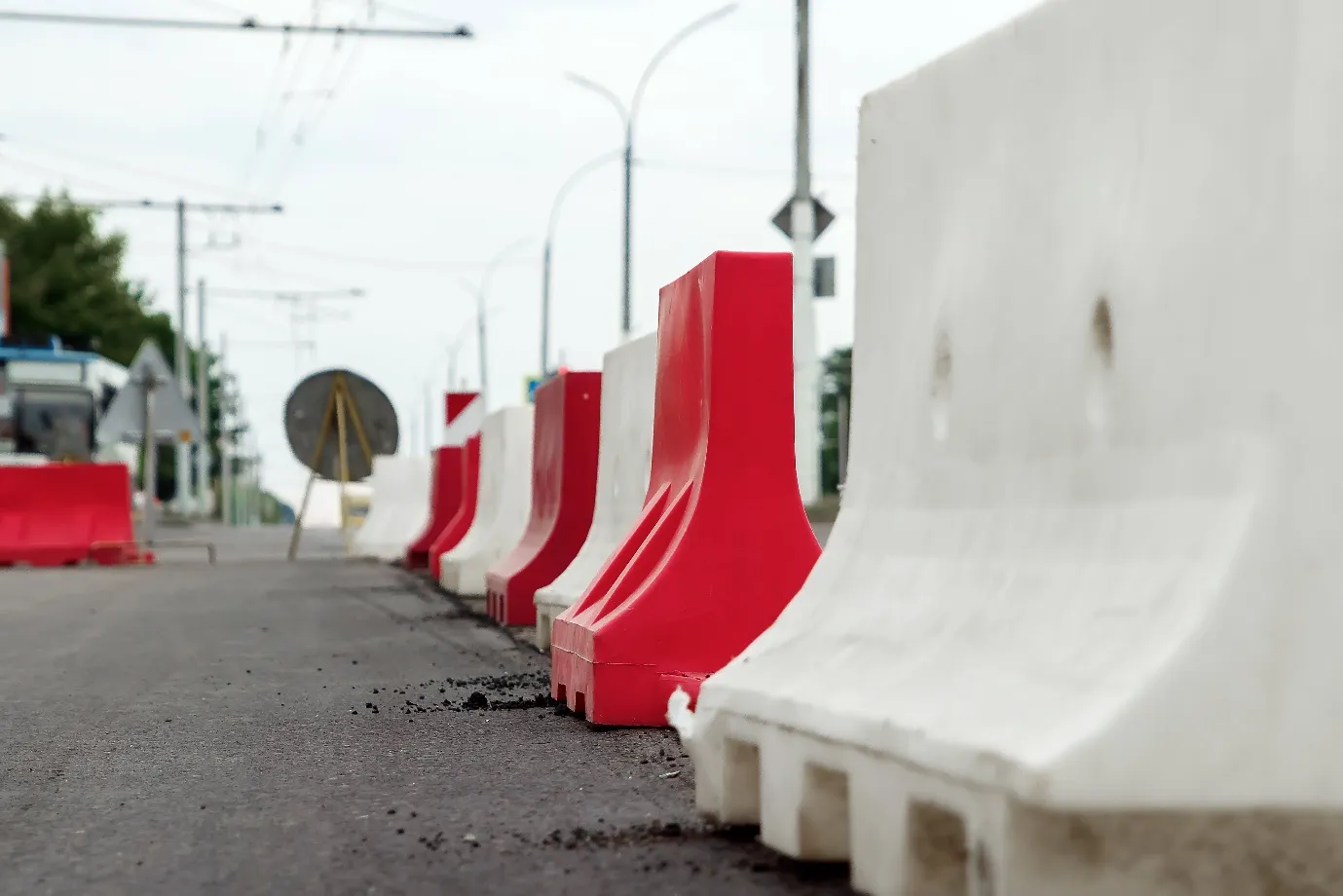
Plastic barriers serve a different purpose. Their lighter construction makes them easier to handle, move and install, which is useful for short-term diversions, events, temporary road closures and construction zones that change frequently. Many designs can be filled with water or sand after positioning to provide additional stability.
For projects investigating Used Plastic Road Barriers UAE, condition remains important even though the units are comparatively simple to relocate. Teams should look for damage that could affect connection points, visibility or the ability to hold ballast. A serviceable used barrier can be practical where flexibility and repeated repositioning are priorities.

The Operational Implications of Weight and Mobility
Barrier weight directly affects project operations. Concrete units provide stability but require more planning whenever the layout changes. Plastic units can usually be adjusted more quickly, allowing crews to open, close or redirect routes as work areas shift. That flexibility can reduce disruption during short construction phases or maintenance activities. On fast-moving projects, that difference can influence how quickly crews can respond to changing access requirements.
Mobility also influences storage and transport. Lightweight barriers may be easier to stack, load and redeploy between sites, while concrete barriers demand greater lifting capacity and vehicle space. Project managers should therefore include handling requirements in the traffic-management plan instead of considering only the barrier purchase cost.
Visibility and Driver Guidance Still Matter
No barrier performs effectively if road users cannot understand the route. High-visibility finishes, reflective elements, warning signs and sensible spacing all contribute to a clearer traffic environment. Plastic barriers are particularly useful where color and visual guidance are central to the temporary layout, while concrete units can also be supplemented with reflective markings.
Site teams should review visibility during both daylight and night-time conditions. Dust, construction lighting, parked machinery and changing traffic directions can alter how easily a barrier line is recognized. Regular checks help confirm that the installation continues to communicate the intended route as work progresses. Inspections should also confirm that displaced, damaged or poorly aligned units are corrected before they become part of the normal traffic pattern.
Combining Barrier Types on Complex Projects
Concrete and plastic systems do not always need to compete for the same application. On a large project, concrete barriers may protect a more permanent work boundary while plastic barriers manage temporary access lanes inside or around the site. Using each type according to its strengths can create a more efficient overall arrangement.
This mixed approach is particularly useful on phased developments where some boundaries remain fixed for months while others move weekly. It can also help control costs by reserving heavier barriers for higher-consequence areas and using lighter systems where rapid adjustment is more valuable than maximum physical mass.
Conclusion
The implications of barrier selection extend beyond basic road safety. Concrete barriers affect transport, lifting and long-term layout planning, while plastic barriers influence flexibility, visibility and the speed at which traffic arrangements can be changed. Both types can be useful when their capabilities match the actual site risk.
A good traffic-control plan therefore starts with the function required at each location. By considering stability, mobility, duration, handling and visibility together, project teams can select barrier systems that improve safety without creating unnecessary operational complications or costs. Reviewing the arrangement as site conditions change helps keep that selection appropriate throughout the life of the project.